
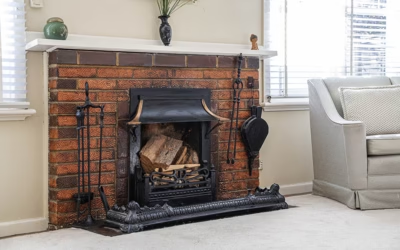
You love having a fireplace. You just don’t love hauling firewood, starting fires, cleaning up ashes, or waiting for the room to finally get warm.
If that sounds familiar, you’re not alone.
Many homeowners throughout Wichita and surrounding Kansas communities have older wood-burning fireplaces they rarely use simply because they’re inconvenient. Instead of removing the fireplace altogether, there may be another option:
Convert your wood-burning fireplace to gas.
In many homes, an existing wood-burning fireplace can be converted to gas, giving you the warmth and atmosphere of a fire with considerably more convenience.
Here’s what Kansas homeowners should know before making the switch.
Why Are Homeowners Switching from Wood to Gas?
There’s something special about a traditional wood-burning fire. The crackling wood, glowing embers, and unmistakable aroma create an experience that’s hard to duplicate.
But traditional wood fires also require work.
You have to:
- Buy or cut firewood
- Store the wood properly
- Carry it inside
- Build and light the fire
- Tend the fire
- Remove ashes afterward
- Maintain the fireplace and venting system
For homeowners who don’t want that routine every time they’d like a fire, gas provides an attractive alternative.
With many modern gas fireplaces, enjoying a fire can be as simple as pressing a button.
What Does Converting a Wood Fireplace to Gas Mean?
There isn’t just one way to convert a wood-burning fireplace.
Depending on your existing fireplace, chimney, heating goals, budget, and desired appearance, there may be different solutions.
Two common options are gas logs and gas fireplace inserts.
Understanding the difference is important.
Option 1: Gas Logs
Gas logs are designed to create the appearance of a traditional wood fire without requiring you to burn actual firewood.
A gas burner and decorative log set are installed within an appropriate existing fireplace.
Advantages of Gas Logs
- Traditional fireplace appearance
- No hauling or storing firewood
- No wood ashes to remove
- Convenient operation
- Often less extensive than a complete fireplace replacement
Gas logs are particularly attractive to homeowners primarily interested in ambiance and convenience.
However, if improving heating performance is a major goal, another option may make more sense.
Option 2: Gas Fireplace Inserts
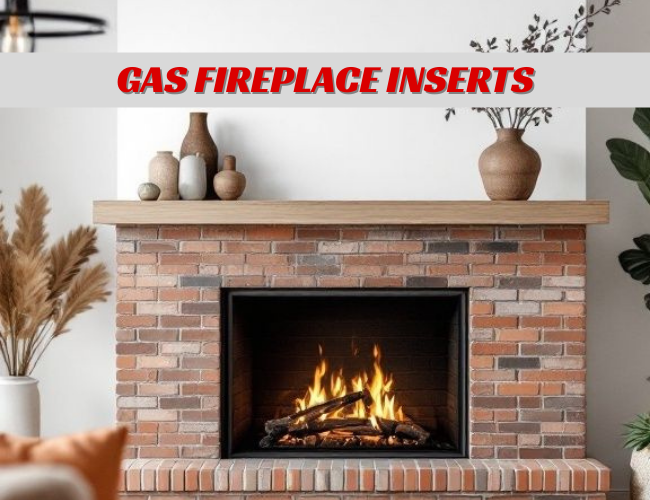
A gas fireplace insert is a self-contained fireplace appliance installed within a compatible existing fireplace opening.
Instead of simply adding flames to the existing firebox, the insert essentially creates a new fireplace system inside the old fireplace.
Modern gas inserts can offer:
- Excellent heat output
- Improved heating efficiency
- Sealed combustion on many models
- Blower systems
- Remote controls
- Thermostat functionality
- Realistic logs and flames
- Modern or traditional styling
For Kansas homeowners who want their fireplace to provide meaningful supplemental heat, a gas insert can be an excellent option.
Gas Logs vs. Gas Inserts: What’s the Difference?
The best choice depends largely on what you want from your fireplace.
Choose Gas Logs If:
You primarily want:
- Ambiance
- Traditional appearance
- Easier operation
- Less mess than wood
Consider a Gas Insert If:
You want:
- More usable heat
- Better efficiency
- Controlled heating
- A more substantial fireplace upgrade
- Modern features and convenience
A professional evaluation can help determine which solution makes the most sense for your existing fireplace.
What Are the Benefits of Converting from Wood to Gas?
1. Push-Button Convenience
This is probably the biggest reason homeowners make the switch.
Instead of building a fire, many gas systems allow you to enjoy flames using a remote control or wall switch.
Come home on a cold Kansas evening, turn on the fireplace, and start enjoying it.
2. No More Firewood
Firewood requires space.
It also needs to be properly seasoned and stored.
Switching to gas eliminates:
- Wood piles
- Trips outside during cold weather
- Bark and debris inside the house
- Bugs hitching a ride indoors
- Constantly restocking firewood
For many homeowners, this alone makes the conversion worthwhile.
3. Less Cleanup
Wood fires create ash and debris.
Gas eliminates the routine cleanup associated with burning wood, making your fireplace considerably easier to enjoy.
4. More Consistent Heat
Wood fires naturally fluctuate as the wood burns.
Modern gas fireplaces and inserts allow homeowners to achieve more predictable heat output.
Depending on the selected system, you may also have control over:
- Flame height
- Temperature
- Blower speed
- Thermostat settings
That makes it easier to maintain a comfortable living space.
5. Updated Fireplace Design
Converting to gas is also an opportunity to update your fireplace’s appearance.
Homeowners can combine a new gas insert with:
- Stone surrounds
- Large-format tile
- Updated hearths
- New mantels
- Built-in shelving
- Complete fireplace feature walls
An outdated fireplace can become one of the most impressive features in your home.
Is Every Wood-Burning Fireplace Convertible to Gas?
Not necessarily.
Your existing fireplace and home need to be evaluated first.
Important considerations include:
- Fireplace construction
- Firebox dimensions
- Existing chimney or venting
- Condition of the fireplace
- Available gas service
- Gas line routing
- Manufacturer requirements
- Required clearances
- Applicable local codes
That’s why it’s better to have your fireplace evaluated before purchasing a gas insert or log set.
The unit needs to match both your fireplace and the home’s installation requirements.
Do You Need a Gas Line?
Yes, a gas fireplace requires an appropriate fuel supply.
If your home already uses natural gas for a furnace, water heater, range, or another appliance, it may be possible to extend gas service to the fireplace.
Homes without existing natural gas may have other possibilities depending on the selected appliance and available fuel sources.
The system should be evaluated and installed by qualified professionals.
What Happens to the Existing Chimney?
This depends on the type of gas system being installed.
A gas insert may use a manufacturer-approved venting system routed through the existing chimney, while other fireplace configurations have different venting requirements.
The existing chimney also needs to be evaluated for suitability and condition.
You should never assume that an old chimney is automatically ready for a new gas appliance.
How Long Does a Wood-to-Gas Fireplace Conversion Take?
The timeline depends on the project.
A straightforward conversion may be completed relatively quickly, while projects involving:
- New gas lines
- Venting modifications
- Fireplace repairs
- Custom surrounds
- Stonework
- Tile
- Mantels
- Framing
may require additional time.
A consultation allows the installation team to evaluate the project and provide a more accurate timeline.
How Much Does It Cost to Convert a Wood Fireplace to Gas?
There’s no single price because every fireplace is different.
The total investment depends on factors such as:
- Gas logs versus a gas insert
- Selected fireplace model
- Gas line requirements
- Venting
- Existing fireplace condition
- Installation complexity
- Electrical requirements
- Surround and finish upgrades
If you’re already considering remodeling the fireplace, it can make sense to coordinate the gas conversion and cosmetic improvements as one project.
Is Gas Better Than Wood?
Neither option is automatically “better.”
It comes down to how you want to use your fireplace.
Wood May Be Better If You:
- Love building real fires
- Have easy access to firewood
- Enjoy the traditional fireplace experience
- Don’t mind maintenance and cleanup
Gas May Be Better If You:
- Want quick operation
- Don’t want to store firewood
- Prefer less cleanup
- Want controlled heat
- Use your fireplace frequently
- Want modern convenience
For many busy Kansas households, convenience is what ultimately makes gas the preferred option.
Frequently Asked Questions About Wood-to-Gas Fireplace Conversions
Can I put a gas insert into my existing wood-burning fireplace?
Many existing fireplaces can accommodate gas inserts, but the fireplace needs to be evaluated for dimensions, condition, venting, and compatibility.
Do gas fireplace inserts provide real heat?
Yes. Many modern gas inserts are specifically designed to provide supplemental heat and can be considerably more effective than an open masonry fireplace.
Can I convert back to wood later?
That depends on the conversion method and modifications made during installation. If keeping future wood-burning capability matters to you, discuss that before choosing a system.
Does a gas fireplace work during a power outage?
Some gas fireplace models may operate during a power outage, while certain features such as blowers or electronic controls may require electricity. Always check the specifications of the particular model you’re considering.
Do gas fireplaces require maintenance?
Yes. Gas fireplaces generally require less routine work than wood-burning fireplaces, but they still need appropriate inspection and maintenance according to the manufacturer’s recommendations.
Is a Wood-to-Gas Conversion Right for Your Kansas Home?
If you love having a fireplace but rarely use it because burning wood is too much work, converting to gas could completely change how often you enjoy your fireplace.
Instead of saving it for special occasions, your fireplace can become something you use throughout the winter.
One button.
Real flames.
Reliable warmth.
No trip to the woodpile.
For many homeowners, that’s exactly the fireplace experience they’ve been looking for.
Explore Your Gas Fireplace Options with DOD Installations
At DOD Installations, we help homeowners determine whether their existing wood-burning fireplace can be upgraded to gas and which solution makes the most sense for their home.
Whether you’re considering gas logs, a high-efficiency gas fireplace insert, or a complete fireplace remodel, we’ll help you understand your options before making a decision.
We proudly serve Wichita, Derby, Andover, Maize, Valley Center, Goddard, Haysville, El Dorado, Newton, Hutchinson, Kingman County, Sumner County, Cowley County, and surrounding Kansas communities.
Ready to make your old fireplace easier to enjoy?
Call DOD Installations at (316) 393-7500 or visit our website to schedule a consultation.
0 Comments